Monday, 18 May 2026

Emirates and flydubai Boost Global Connectivity and Traveller Rewards

Published: Thursday, November 20, 2025
Emirates and flydubai Boost Global Connectivity and Traveller Rewards

Emirates and flydubai have solidified their partnership as a model of industry collaboration, providing travellers with unparalleled connectivity and a seamless journey across an expansive global network. The partnership continues to reward Emirates Skywards members through a joint loyalty programme, offering significant benefits to millions of passengers.

Key Highlights of the Emirates and flydubai Partnership:

  1. A Global Network at Your Fingertips:
    The collaboration between Emirates and flydubai spans 245 destinations in 103 countries, unlocking a wide range of travel options for customers.

  2. Expanding Horizons:
    Emirates passengers now have access to 103 additional flydubai destinations, while flydubai travellers can explore 107 exclusive Emirates destinations. Popular locations include Kathmandu, Baku, Krabi, Belgrade, and Zanzibar.

  3. New Destinations Added in 2025:
    The partnership continues to grow, with Emirates adding new destinations like Hangzhou, Shenzhen, Siem Reap, and Da Nang, while flydubai expands its offerings with cities such as Chisinau, Iasi, Vilnius, Riga, and Nairobi.

  4. Growing Passenger Numbers:
    In the last year alone, both airlines carried over 5 million passengers on codeshare flights, reflecting a 10% increase compared to the previous year. Since 2017, more than 22 million customers have enjoyed seamless travel across both carriers' networks.

  5. Premium Travel Options:
    Emirates' premium cabins (First Class, Business Class, and Premium Economy) saw a 20% increase in bookings, with Premium Economy growing by an impressive 130%. The partnership enhances travel experiences, offering a greater range of premium options for passengers.

  6. Seamless Travel Experience:
    From simplified check-ins and baggage transfers to optimised schedules, the collaboration ensures smooth travel. flydubai Business Class passengers enjoy a premium service experience at Terminal 2 in Dubai, with personalised assistance, seated check-in, and Fast Track priority.

  7. Exclusive Loyalty Rewards:
    Emirates Skywards, the award-winning loyalty programme, allows nearly 18 million members to earn and redeem Skywards Miles for a variety of rewards. Members enjoy additional perks, including lounge access, extra baggage allowances, and priority check-ins across both airlines.

  8. Miles that Go Further:
    The recently launched Classic Rewards offer a simplified way to use Skywards Miles to book flights. With as little as 5,000 Miles, members can enjoy flights to over 130 destinations, including popular seasonal spots like Mykonos and Bodrum. The enhanced Cash+Miles option also provides greater value, with members saving AED 100 for every 3,500 Miles used.
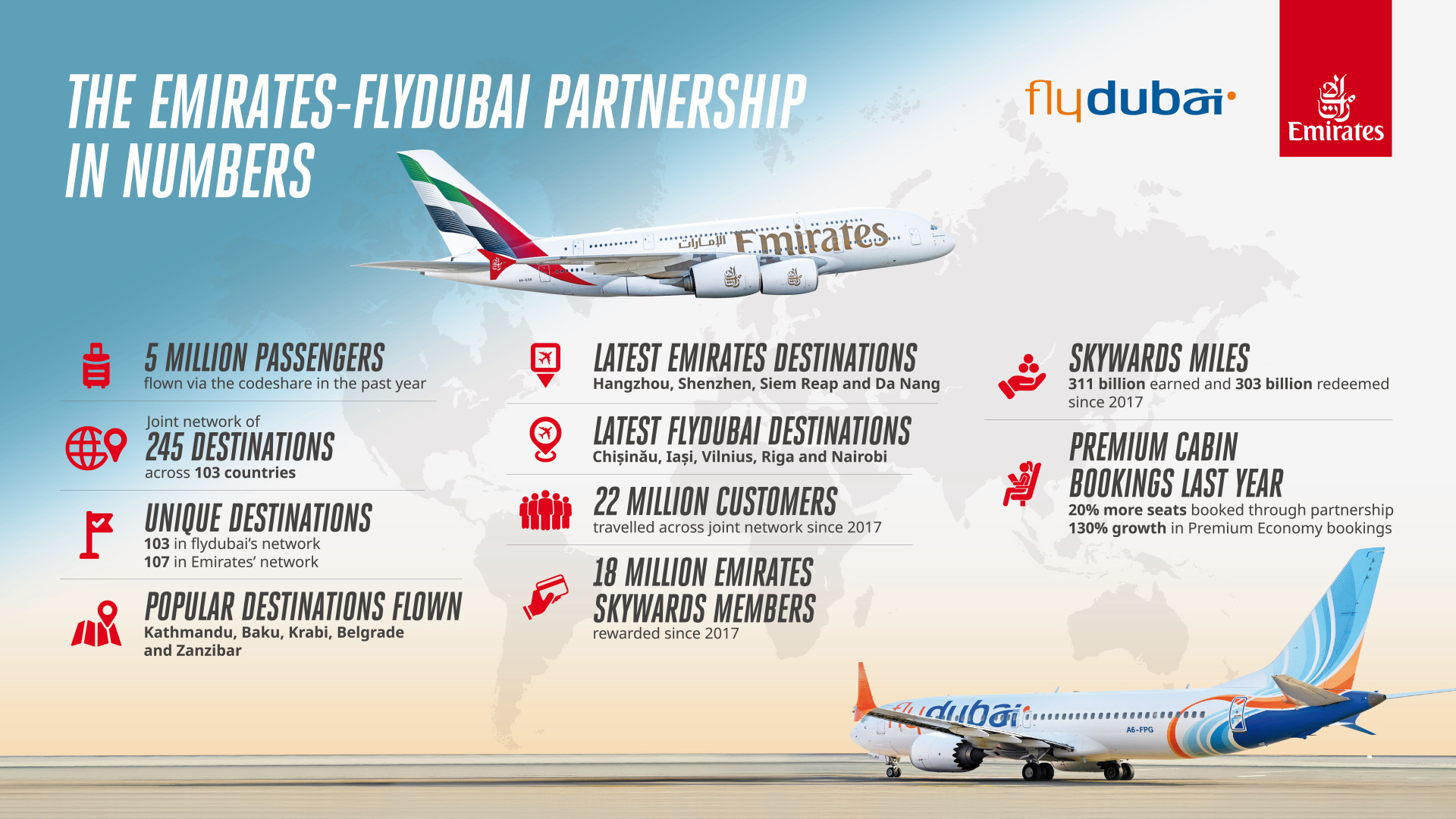
Photo: Emirates

Ongoing Fleet Enhancements:
Emirates continues its extensive fleet retrofit programme, upgrading nearly 220 aircraft with new cabins, including Premium Economy. Flydubai is also modernising its fleet, retrofitting 15 aircraft this year and introducing a dedicated Business Class check-in area at Terminal 2.

A Combined Fleet of Modern Aircraft:
Together, Emirates and flydubai operate a fleet of 363 modern aircraft. Emirates' fleet of 267 widebody aircraft includes A380s, B777s, and A350s, while flydubai operates 96 B737 aircraft.

Supporting Dubai’s Vision:
As part of Dubai's D33 Economic Agenda, Emirates and flydubai are committed to expanding their combined network to 400 destinations from Dubai, further strengthening the emirate's role as a global aviation hub.

This strategic partnership continues to enhance connectivity, elevate travel experiences, and contribute to Dubai's growing importance on the global stage.

Air Arabia Posts $75.54 Million Net Profit in First Quarter of 2026

Published: Sunday, May 17, 2026
Air Arabia Posts $75.54 Million Net Profit in First Quarter of 2026

Sharjah-based budget carrier Air Arabia has announced its financial results for the quarter ending March 31, 2026, showing a decline in profit despite steady revenue growth and strong passenger demand.

The airline posted a net profit of AED 278 million for the first three months of the year, down 22% from AED 355 million recorded in the same period last year. The company attributed the decline primarily to operational disruptions linked to ongoing regional conflict, which led to airspace closures and temporary capacity reductions.

Revenue for the quarter rose slightly to AED 1.8 billion, reflecting a 1% increase year-on-year. Despite reduced capacity in parts of March, demand for Air Arabia’s services remained strong across its network.

Passenger numbers reached 4.7 million across its operating hubs during the quarter, representing a 5% decline compared to the previous year. However, the airline’s average seat load factor improved to 86%, up by two percentage points, indicating higher efficiency in seat utilization.

Chairman Sheikh Abdullah Bin Mohammad Al Thani said the carrier had demonstrated resilience in a difficult operating environment, noting its ability to adapt quickly to changing conditions and maintain continuity across its operations. He highlighted disciplined cost control, a multi-hub operating model, and sustained customer demand as key contributors to the airline’s quarterly performance.

During the period, Air Arabia operated a fleet of 90 Airbus A320 and A321 aircraft across hubs in the United Arab Emirates, Morocco, Egypt, and Pakistan. The airline also confirmed additional aircraft deliveries are expected throughout the year as part of its existing Airbus order pipeline.

In February, the carrier was included in Forbes Middle East’s Top 100 Most Valuable Companies 2026, reflecting its market position and financial standing.

On the sustainability front, the airline secured a Limited Assurance Statement for its 2025 ESG report under the ISAE 3000 international standard, reinforcing its commitment to transparency and governance practices.

Looking ahead, the chairman warned that geopolitical uncertainty, fuel price volatility, inflationary pressures, and global supply chain challenges are expected to continue affecting the aviation sector. However, he expressed confidence in the regions served by the airline and said the company would continue to focus on operational discipline and efficiency while maintaining customer value.

Source: ZAWYA

Qatar Airways Adds New Destinations Across the Americas

Published: Tuesday, May 12, 2026
Qatar Airways Adds New Destinations Across the Americas

Qatar Airways will expand its operations in the Americas with the launch of new flights to Caracas, Venezuela, and Bogotá, Colombia, starting on July 22, 2026. The move marks a major step in the carrier’s international growth strategy and strengthens air links between the Middle East and Latin America.

The airline said it will become the first Gulf carrier to operate services to Venezuela and the first airline to offer direct connectivity from West Asia to both Caracas and Bogotá. The expansion follows a broader commitment announced in 2025 to improve global access to the region.

Qatar Airways plans to operate two flights each week to the two cities. The schedule has been designed to provide convenient onward connections through Hamad International Airport to destinations including Australia, China, Japan, Lebanon, South Korea, and the United Arab Emirates.

According to the airline, the new routes will improve transfer flexibility for passengers travelling across its global network. Caracas and Bogotá will become the 15th and 16th destinations served by Qatar Airways in the Americas. The carrier first entered the South American market in 2010 with flights to São Paulo, Brazil.

Qatar Airways also said it is rebuilding its worldwide network to more than 160 destinations during the 2026 summer season.

Source: GULF TIMES

UAE Lifts All Airspace Restrictions After Iran Conflict

Published: Wednesday, May 06, 2026
UAE Lifts All Airspace Restrictions After Iran Conflict

The United Arab Emirates has fully restored normal air traffic operations after lifting restrictions imposed during the US-Israel conflict with Iran. Authorities said the decision followed security assessments and coordination with relevant agencies as regional aviation activity continues to recover.

The United Arab Emirates has officially lifted all air traffic restrictions that had been introduced during the conflict involving the United States, Israel, and Iran, according to the country’s aviation regulator.

In a statement issued on Saturday, the UAE General Civil Aviation Authority (GCAA) confirmed that air operations across the country’s airspace have returned to normal conditions. The authority said the move followed an extensive review of operational and security circumstances conducted in coordination with relevant agencies.

Officials added that the situation would continue to be monitored closely to ensure the safety and stability of air navigation across UAE skies.

The development represents a major step toward recovery for the UAE’s aviation sector, particularly for Dubai and Abu Dhabi, two of the region’s most significant international air transport hubs. Dubai is home to the world’s busiest airport for international passenger traffic.

The regional conflict had heavily disrupted aviation operations across the Middle East after retaliatory attacks and escalating tensions forced multiple countries to close or restrict parts of their airspace.

Several Gulf and regional states, including the UAE, Qatar, Bahrain, Kuwait, Iraq, and Jordan, imposed either complete or partial airspace closures during the peak of the crisis.

Major UAE carriers were also affected. Emirates and flydubai temporarily suspended operations, while Etihad Airways halted departures from Abu Dhabi during the conflict period.

According to aviation analytics company Cirium, more than 11,000 flights across the Middle East were cancelled during the early stages of the war, severely affecting travel between Europe and Asia and limiting available long-haul routes.

The UAE initially introduced a temporary partial closure of its airspace in late February before gradually easing restrictions in March.

Between March 1 and March 12, UAE airports handled approximately 1.4 million passengers and recorded 7,839 aircraft movements as operations slowly resumed. During that period, national carriers restored around 44.6 percent of their normal flight activity levels.

A ceasefire brokered by Pakistan last month helped bring the conflict to an end, paving the way for the UAE’s latest announcement on the full normalization of air traffic operations.

Elsewhere in the region, signs of aviation recovery are also becoming increasingly visible. Qatar Airways announced on Saturday that it would restart flights to three cities in Iraq from May 10. The airline had previously revealed plans to expand services to more than 150 destinations across six continents beginning in mid-June.

UAE Orders Up to 20 Embraer C-390 Military Aircraft

Published: Wednesday, May 06, 2026
UAE Orders Up to 20 Embraer C-390 Military Aircraft

Brazilian aerospace manufacturer Embraer has secured its first defence aircraft sale in the Middle East after the United Arab Emirates agreed to acquire up to 20 C-390 Millennium military transport aircraft.

The agreement was signed on 4 May between the UAE’s Tawazun Council for Defence Enablement and Embraer. Under the deal, Abu Dhabi confirmed an initial purchase of 10 C-390 aircraft, while retaining options for an additional 10 jets.

The aircraft will be deployed to enhance the UAE Air Force’s operational transport and humanitarian response capabilities. Planned missions include troop and cargo transport, aerial delivery operations, medical evacuation, and logistical support.

An Emirati defence company, which was not identified, will collaborate with Embraer as part of the programme.

Nasser Humaid Al Nuaimi, secretary general of the Tawazun Council, described the acquisition as a major boost to the country’s military airlift capacity. He said the C-390 was selected following extensive technical and operational assessments focused on performance, reliability, and compatibility with the UAE’s existing defence systems.

The agreement represents a major breakthrough for Embraer’s defence division, marking the company’s first military aircraft sale in the Middle East. It is also the largest export order yet for the C-390 programme.

If the UAE exercises all purchase options, its fleet would exceed even Brazil’s current order of 19 C-390 tanker-transport aircraft.

Bosco da Costa Junior, chief executive of Embraer Defense & Security, said the company aims to establish a long-term partnership with the UAE while providing full operational support for the aircraft programme.

The C-390 programme has gained momentum internationally over the past two years, with Embraer securing orders from countries including Sweden, Hungary, Lithuania, the Netherlands, Austria, South Korea, Slovakia, and the Czech Republic. Portugal, the launch export customer, has also expanded its order.

Embraer is additionally pursuing opportunities in the United States through a partnership with Northrop Grumman to develop an aerial refuelling boom system for the tanker version of the C-390.

Separately, Embraer recently completed assembly of the first Brazilian-built F-39E fighter jet for the Brazilian Air Force. The aircraft is the local designation for Saab’s Gripen E/F fighter and is being manufactured in Brazil through a joint industrial programme between Saab and Embraer.

The F-39E is regarded as the first supersonic fighter aircraft produced in Latin America.

Embraer has also continued to expand exports of its A-29 Super Tucano light-attack aircraft, recording recent sales to Uruguay, Panama, Nigeria, and Portugal.

Spirit Refunds Majority of Customers After Halting Operations

Published: Wednesday, May 06, 2026
Spirit Refunds Majority of Customers After Halting Operations