Wednesday, 01 April 2026

How to Spend 24 Hours in Doha: A Complete Guide

Make every moment count with our insider’s guide to a perfect 24 hours in Doha.
Published: Wednesday, October 29, 2025
How to Spend 24 Hours in Doha: A Complete Guide

Whether you’re on a layover in Qatar’s vibrant capital or you’ve got just one free day to explore, Doha is far too fascinating to spend indoors. In just 24 hours, you can experience the city’s stunning blend of tradition and innovation — from futuristic skylines to time-worn souqs and shimmering desert-inspired architecture.

So set your alarm, lace up your most comfortable shoes, and get ready — here’s how to make every hour count.

Morning: Start in the Future at Lusail City

Just 20 minutes north of central Doha lies Lusail City, the country’s gleaming symbol of modern ambition. Here, architectural marvels like the crescent-shaped Katara Towers — home to Qatar’s first six-star hotel — and the block-like Marina Twin Towers create a skyline straight out of science fiction.

Take a stroll along Lusail Boulevard, where futuristic design meets local flair, and stop for photos at the famous floating whale sculpture. Nearby, adrenaline seekers can head to Meryal Waterpark on Qetaifan Island North, or enjoy panoramic views from the Glass Bridge.

Late Morning: Chill and Shop at West Walk

Next, head to West Walk, Doha’s chic lifestyle destination. With more than 160 boutiques, cafés, and restaurants — plus outdoor air-conditioning — this area makes al fresco dining a breeze even in summer.

Wander the promenade, window shop, or sip something cold while soaking in the city vibe.

Midday: Caffeine Fix at Msheireb Downtown Doha

For your caffeine stop, hop on the tram at Msheireb Downtown Doha, a model of sustainable urban living. Grab a coffee at one of the sleek cafés and take in the blend of heritage and innovation.

Don’t miss the Msheireb Museums, where restored heritage houses trace the city’s transformation from pearl-diving village to modern metropolis.

Early Afternoon: Souq Waqif — Where Time Stands Still

A short stroll through the underpass connects modern Msheireb with old-world Souq Waqif. Suddenly, the glass towers give way to mud-brick alleys, spice stalls, and the aroma of sizzling kebabs.
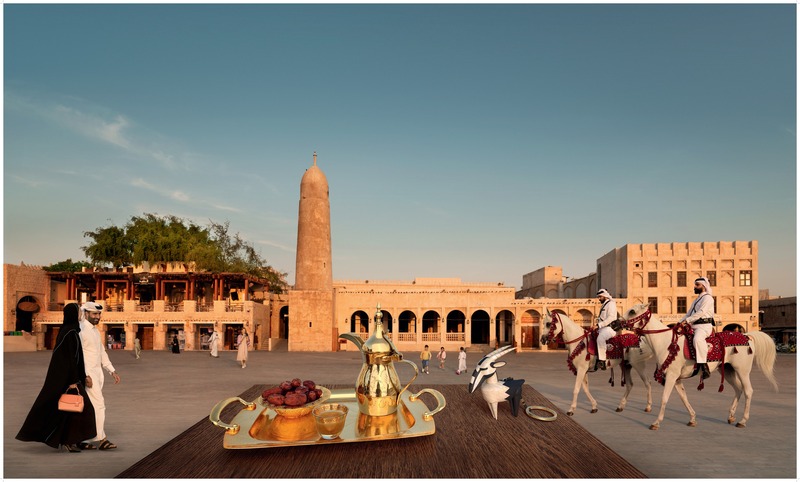
Haggle for souvenirs, watch falcons being trained, and pose by the famous thumb sculpture or the spiral Fanar Mosque in the distance.

Hungry? Stop by Shay Al Shomoos, one of Doha’s most beloved breakfast spots, where Shams Al Qassabi — the first woman to open a business in the souq — serves up Qatari classics like regag bread and egg dishes.
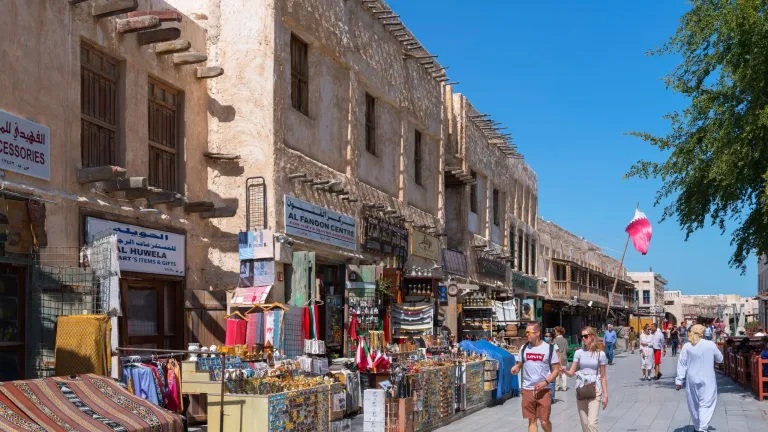
Before you leave, drop by the Souq Waqif Art Center for a glimpse of local artists at work.

Afternoon: Art and Architecture at MIA Park

Walk through another underpass to the Corniche, where traditional wooden dhows bob against the turquoise sea. At the tip of the promenade sits MIA Park, offering one of the best skyline views of West Bay.

While you’re there, visit the Museum of Islamic Art (MIA) — a masterpiece by architect I.M. Pei. Inside, discover centuries of Islamic art and artefacts that span continents and dynasties.

Open Sat–Thu 9am–7pm; Fri 1.30pm–7pm. mia.org.qa

Evening: Learn and Dine at the National Museum of Qatar

As the sun dips, head to the petal-shaped National Museum of Qatar, designed by Jean Nouvel and inspired by desert rose crystals. Inside, immersive exhibits trace the nation’s story — from Bedouin traditions to oil wealth and beyond.

Open Sat–Thu 9am–7pm; Fri 1.30pm–7pm. nmoq.org.qa

After your visit, dine at Jiwan, the museum’s signature restaurant by Alain Ducasse. Expect refined Qatari flavors with a contemporary touch, paired with sweeping views of the museum’s architecture and the Doha skyline.

Prefer plant-based plates? Thalatheen, just outside the museum, serves creative vegan fare.

Night: Culture, Canals, and Culinary Delights

Make your way to Katara Cultural Village, Doha’s creative heart. Marvel at the grandeur of the Katara Amphitheatre, the glittering Golden Mosque, and the celestial wonders inside the Al Thuraya Planetarium. Don’t miss the vibrant street art — especially the “Oryx Going Ahead” mural.

From there, head to Qanat Quartier, where pastel-colored buildings and serene canals give the area a distinctly Venetian charm. Cross the Rialto Bridge replica, discover the playful piano steps, or glide along the waterways in a water taxi.

Dinner and Drinks: Gewan Island and Beyond

Wrap up your whirlwind day with dinner on Gewan Island, a short walk from Qanat Quartier. Take your pick from chic eateries along the crystal walkway — from BRD’s roasted chicken to Fenyal’s Qatari comfort food or Soy by Sato’s Asian fusion.

Still got energy to spare? Doha’s nightlife awaits. Whether you’re craving a quiet rooftop view, a lively pub, or a sports bar screening the latest match, the city has something for every night owl.

One day, a lifetime of memories.

Doha’s magic lies in its contrasts — futuristic skylines rising beside ancient souqs, high design meeting desert tradition. And while 24 hours might not be enough to see it all, it’s more than enough to fall in love with the city’s rhythm.

So next time you’ve got a layover in Doha — step outside. The city’s waiting.

Gulf Air Extends Temporary Dammam Flights Through April 2026

Published: Tuesday, March 31, 2026
Gulf Air Extends Temporary Dammam Flights Through April 2026

Gulf Air has announced the continuation of its temporary network via Dammam, extending operations to various international destinations through April 2026. Travel arrangements between Bahrain and Dammam will be provided for confirmed passengers.

Gulf Air has confirmed that its temporary Dammam network will continue operating through April 2026. Key extensions include:

  • Paris (CDG): Operations extended until 5 April 2026
  • London Heathrow (LHR): Operations extended until 11 April 2026
  • Mumbai (BOM), Nairobi (NBO), Cairo (CAI), Chennai (MAA), Bangkok (BKK), Manila (MNL), Casablanca (CMN), Frankfurt (FRA): Operations extended until 30 April 2026

Passengers with confirmed bookings will be provided transportation between Bahrain and Dammam. Gulf Air will also facilitate Saudi transit visas for travelers connecting to Saudi Arabia via the airline’s arranged land transportation. Passengers whose final destination is Saudi Arabia are required to hold a valid visa independently.

Gulf Air advises passengers not to proceed to their departure station without a confirmed ticket. Flights to and from Bahrain International Airport remain temporarily suspended.

Spain Denies Airspace Access to US Aircraft in Iran Conflict

Published: Tuesday, March 31, 2026
Spain Denies Airspace Access to US Aircraft in Iran Conflict
Source: U.S. Air Force

Spain has prohibited United States military aircraft involved in the ongoing Iran conflict from using its airspace, a move that highlights growing friction between Washington and European allies.

Defence Minister Margarita Robles confirmed that neither Spanish military bases nor national airspace would be available for operations connected to the war. She described the conflict, initiated by the US and Israel about a month ago, as both “illegal” and “unjust,” reaffirming Madrid’s firm opposition.

The decision reinforces Spain’s position as one of Europe’s most vocal critics of the conflict and is expected to further strain relations with the administration of Donald Trump. Trump had earlier warned of a potential full trade embargo against Spain in response to its stance.

Spanish officials had already indicated that jointly operated US-Spain military bases would not be used in the campaign. Foreign Minister José Manuel Albares said the latest restriction aims to avoid contributing to any escalation.

Meanwhile, the White House suggested on Monday that the conflict could conclude within two weeks, provided Iran agrees to negotiations, warning that failure to do so would result in serious consequences.

Source: The Telegraph

Fuel Crisis Forces Airlines to Cancel Thousands of Flights

Published: Tuesday, March 31, 2026
Fuel Crisis Forces Airlines to Cancel Thousands of Flights

Airlines across the globe are cancelling thousands of flights as the ongoing conflict in Iran pushes jet fuel prices to unprecedented levels, intensifying pressure on the aviation sector.

Data from aviation analytics firm Cirium shows that nearly one in every 20 scheduled flights was cancelled on Monday. This represents a sharp increase compared with the same period last year, reflecting growing strain on airline operations.

The surge in cancellations follows a dramatic rise in fuel costs. Jet fuel prices, which stood at $742 per metric tonne a year ago, have climbed beyond $1,710. The escalation is largely linked to supply disruptions caused by the closure of the Strait of Hormuz, a critical route responsible for transporting roughly one-fifth of the world’s oil.

Crude oil markets have also reacted strongly, with Brent crude prices reaching as high as $116 per barrel during early trading on Monday. Analysts warn that refining jet fuel requires more crude oil than petrol or diesel, amplifying the impact of supply constraints on aviation fuel availability.

Concerns are now shifting from price increases to potential shortages. According to a report by the Financial Times, the United Kingdom is expected to receive its final known shipment of jet fuel from the Middle East this week.

Aviation analyst Alex Macheras cautioned that multiple markets could face severe fuel shortages within days, including major European airport hubs. He indicated that some airports have begun advising airlines to prepare for scenarios where fuel may not be available.

The disruption is not confined to Europe. Airlines across Asia, Africa, and South America are implementing contingency plans, including additional refuelling stops, as the supply situation deteriorates.

Several carriers have already announced capacity reductions. Air New Zealand has cut 1,100 flights through early May, while Scandinavian airline group SAS plans to cancel 1,000 flights next month, primarily affecting domestic routes.

Meanwhile, Vietnam Airlines has warned it may reduce monthly flights by 10 to 20 percent next quarter if jet fuel prices reach between $160 and $200 per barrel. This could impact up to 18 percent of its international services and more than a quarter of its domestic operations.

In the United States, United Airlines has already reduced capacity by approximately 5 percent on less profitable routes, becoming the first major US carrier to take such measures in response to rising fuel costs.

Chief executive Scott Kirby said sustained high oil prices could increase the airline’s expenses by $11 billion, potentially forcing ticket prices to rise by around 20 percent to maintain profitability. He noted that fares have already increased by 15 to 20 percent in recent weeks, warning that higher prices are likely to dampen travel demand.

Kirby added that in a worst-case scenario, oil prices could climb to $175 per barrel and remain above $100 through 2027.

Beyond fuel-related challenges, the conflict has also disrupted travel across the Middle East. Major European carriers, including British Airways, Air France-KLM, and Lufthansa, have suspended multiple routes to and from the region.

Cirium data indicates that approximately 7,049 out of 104,618 scheduled flights—around 7 percent—were cancelled globally on Monday. By comparison, 4,797 out of 102,132 flights, or 4.7 percent, were cancelled on the same day last year.

The impact has been particularly severe in North America, where cancellations reached 14.6 percent of departing flights, significantly higher than the 4.4 percent recorded a year earlier.

Source: The Telegraph

UAE Airfares Surge: What’s Driving the Recent Rise in Ticket Prices?

Published: Tuesday, March 31, 2026
UAE Airfares Surge: What’s Driving the Recent Rise in Ticket Prices?

Airfares from the United Arab Emirates have increased significantly in recent weeks, with travel agencies reporting average rises of 15 to 25 per cent. The surge is being linked to reduced flight schedules by regional carriers, a decline in international airline operations on key routes, and mounting operational expenses such as fuel and insurance.

Industry professionals say the price increase, while noticeable, has not dampened overall travel demand. Instead, it has led to changes in how passengers plan their journeys. Imtiaz Hussain Nasir, chief executive of Pinoy Tourism, noted that travellers are now more price-conscious, often comparing options carefully and booking earlier to avoid further increases. Flexibility with travel dates and routes has also become more common.

Recent travel disruptions have played a role in shaping demand patterns. Many passengers postponed trips rather than cancelling them, leading to a rebound in bookings as services resumed. This combination of delayed and new demand has placed additional pressure on available seats, contributing to higher fares.

Rashida Zahid, vice president of operations at musafir.com, said travellers are increasingly adopting strategic booking habits. According to her, most passengers now secure tickets around eight to ten days before departure, as prices tend to rise sharply within the final few days. While direct flights remain the preferred choice, more travellers are opting for indirect routes when the cost savings are substantial.

The limited presence of international carriers is another factor influencing prices. Rino Steephen, sales manager and partner at Azzam Travel and Tourism, explained that a large share of current flights is being operated by UAE-based airlines such as Emirates, Etihad, and Air India. Reduced competition, he said, is contributing to higher ticket costs.

Popular outbound destinations from the UAE include India, the Philippines, several African nations, Turkey, Thailand, Georgia, Armenia, Malaysia, Singapore, and major European cities such as London, Paris, Milan, and Barcelona.

Flight availability continues to play a critical role in pricing. With fewer direct options, many travellers are choosing longer, indirect journeys, sometimes at higher overall costs, to reach their destinations while managing budgets.

Experts also point to broader global pressures affecting the aviation sector, including rising fuel prices, increased insurance premiums, and operational risks. These factors are feeding into ticket pricing worldwide.

Despite higher fares, booking patterns vary depending on urgency. Some passengers continue to book immediately due to pressing travel needs, while others plan weeks in advance to secure more favourable rates. Airlines, meanwhile, are offering greater flexibility in ticket changes and cancellations to accommodate shifting travel plans.

Looking ahead, industry observers expect demand to remain strong. Nasir said travel activity is likely to recover steadily as operations stabilise, although fares may stay elevated on high-demand routes with limited capacity. Steephen added that while UAE carriers are operating without seat restrictions, the absence of more international airlines continues to shape pricing trends. Any easing of fares, he noted, will depend on how conditions evolve in the coming weeks.

Source: Khaleej Times

Qatar Airways Faces Processing Delays as Refund and Booking Requests Surge

Published: Tuesday, March 31, 2026
Qatar Airways Faces Processing Delays as Refund and Booking Requests Surge

Qatar Airways has announced temporary delays in handling customer service requests, including refunds, citing a significant rise in demand. The airline said response and processing times may be longer than usual, while teams continue to work continuously to address all pending cases.

Under updated guidance, passengers holding confirmed bookings for travel between 28 February and 15 June 2026 are eligible to request either a full refund or a change of travel dates.

For customers with cancelled bookings, the airline clarified that if a booking cannot be retrieved through its system, it is likely already undergoing refund processing, and no further action is required. However, if the booking remains accessible, passengers may apply for a full refund or modify their travel dates. Any additional services purchased alongside tickets will be refunded separately after the main ticket refund is completed.

Passengers who still intend to travel can reschedule their journeys on Qatar Airways-operated flights up to 31 October 2026, subject to seat availability and fare conditions.

The airline noted that refunds will be issued to the original form of payment and may take up to 28 working days to complete. Customers can monitor the progress of their refund requests through the airline’s online tracking system.

For tickets booked through travel agents or third-party platforms, passengers have been advised to contact their original point of purchase to initiate refund requests.

Qatar Airways also directed customers to its official website for further assistance and updated information, including frequently asked questions.